
The Invisible Factory
How the drive for extreme efficiency and "just-in-time" manufacturing has stripped away the resilience necessary to withstand global disruptions

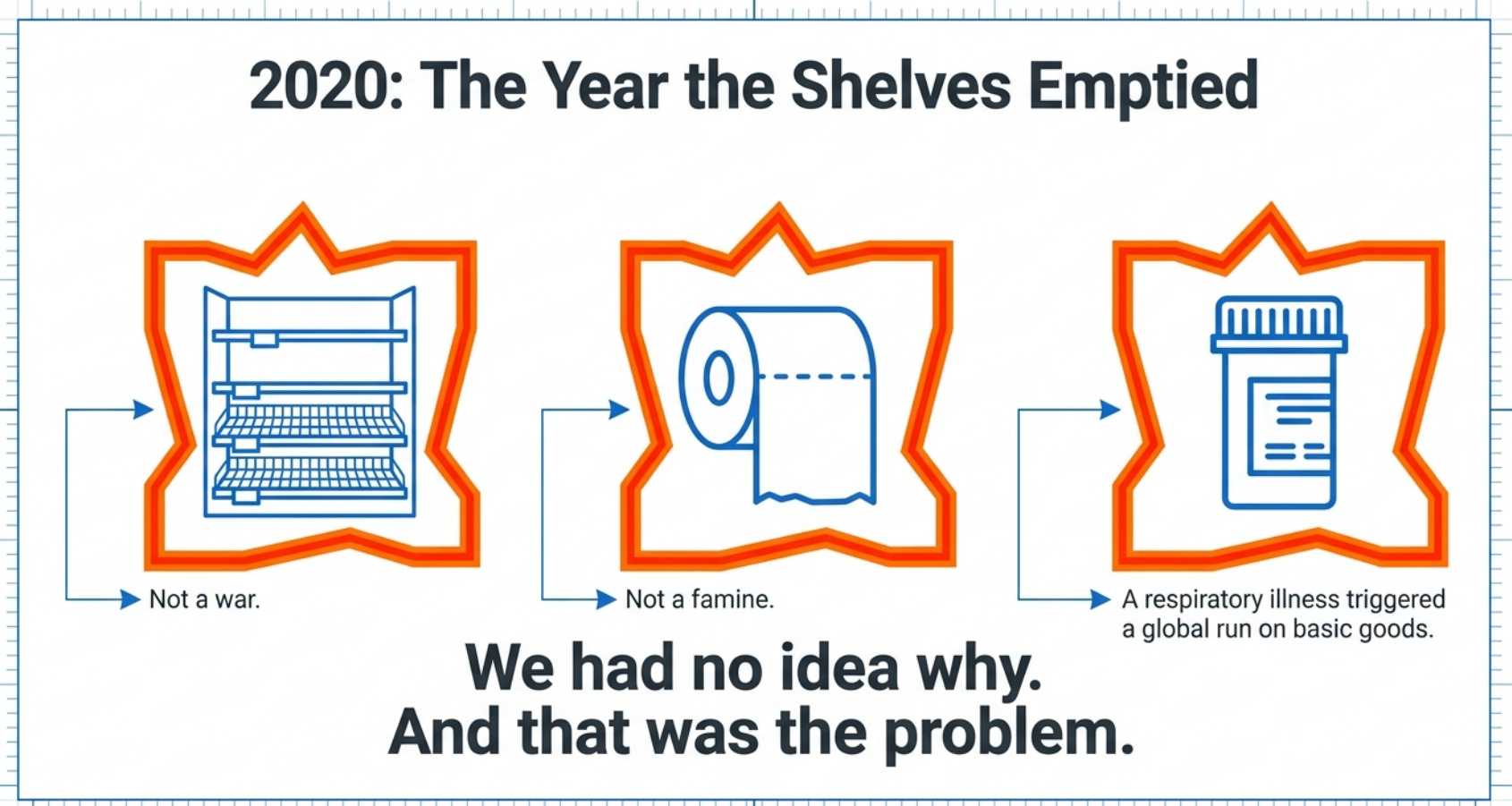
In 2020, people in some of the wealthiest countries on earth found themselves staring at empty supermarket shelves. Not during a war. Not during a famine. During a respiratory illness and a run on toilet paper.
They had no idea why. And that was the problem.
The world has two layers
Tim Minshall, a manufacturing engineering professor at Cambridge, opens his book How Things Are Made with a deceptively simple observation.
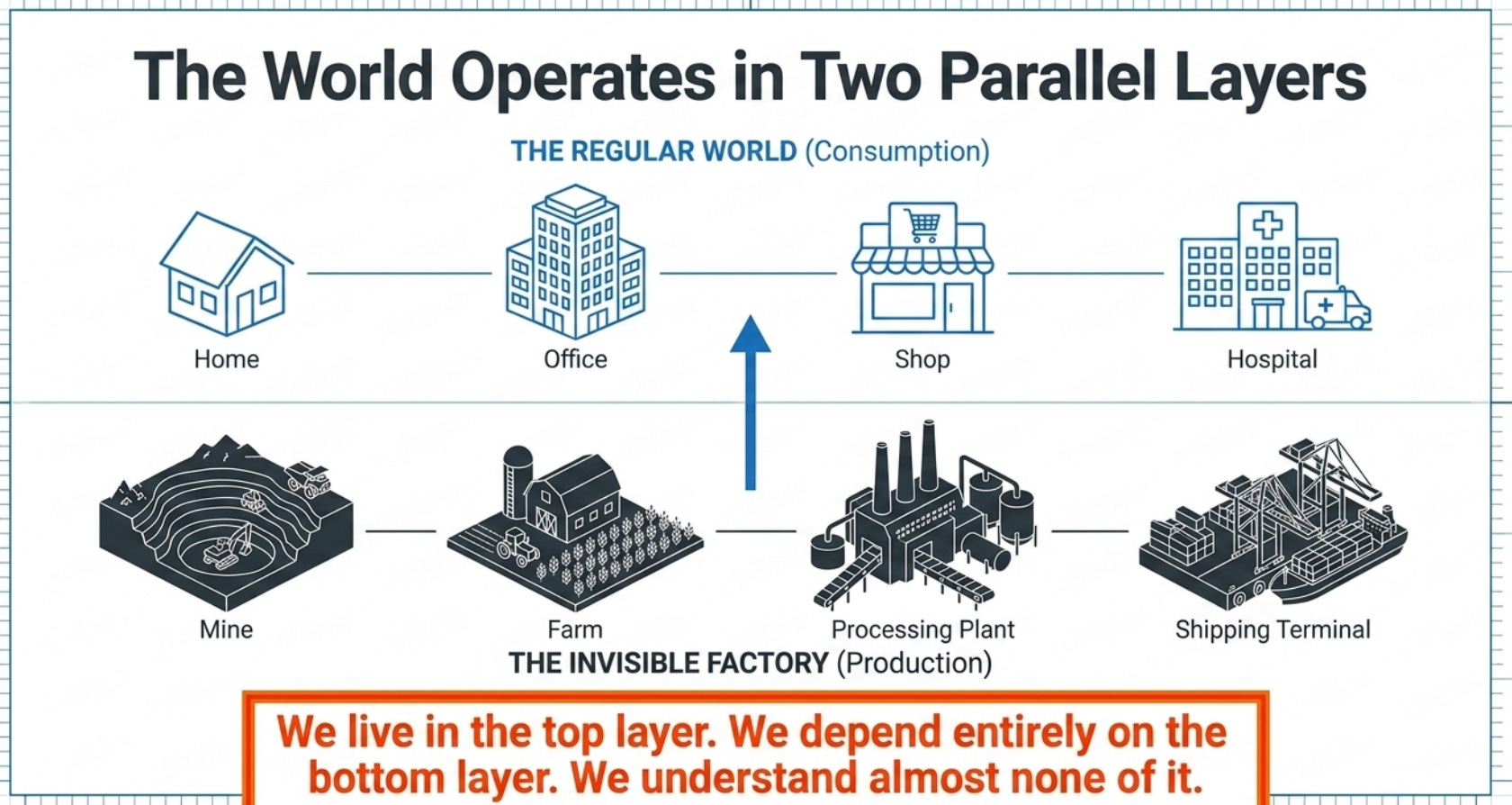
Most of us live in what he calls the “regular world” our homes, offices, shops, hospitals. And then there is a second world, running in parallel: mines, farms, factories, processing plants, warehouses, shipping terminals. This second world feeds the first. And almost none of us have any real understanding of it.
This is not just intellectual ignorance. It is systemic vulnerability.
Go back three centuries and the distance between production and consumption was short enough to be visible. The tailor who made your coat lived in your town. You could see the conditions he worked in. You understood what his labour was worth. The money you paid went back into the community you could see.
Industrialisation stretched that chain. Globalisation snapped it.
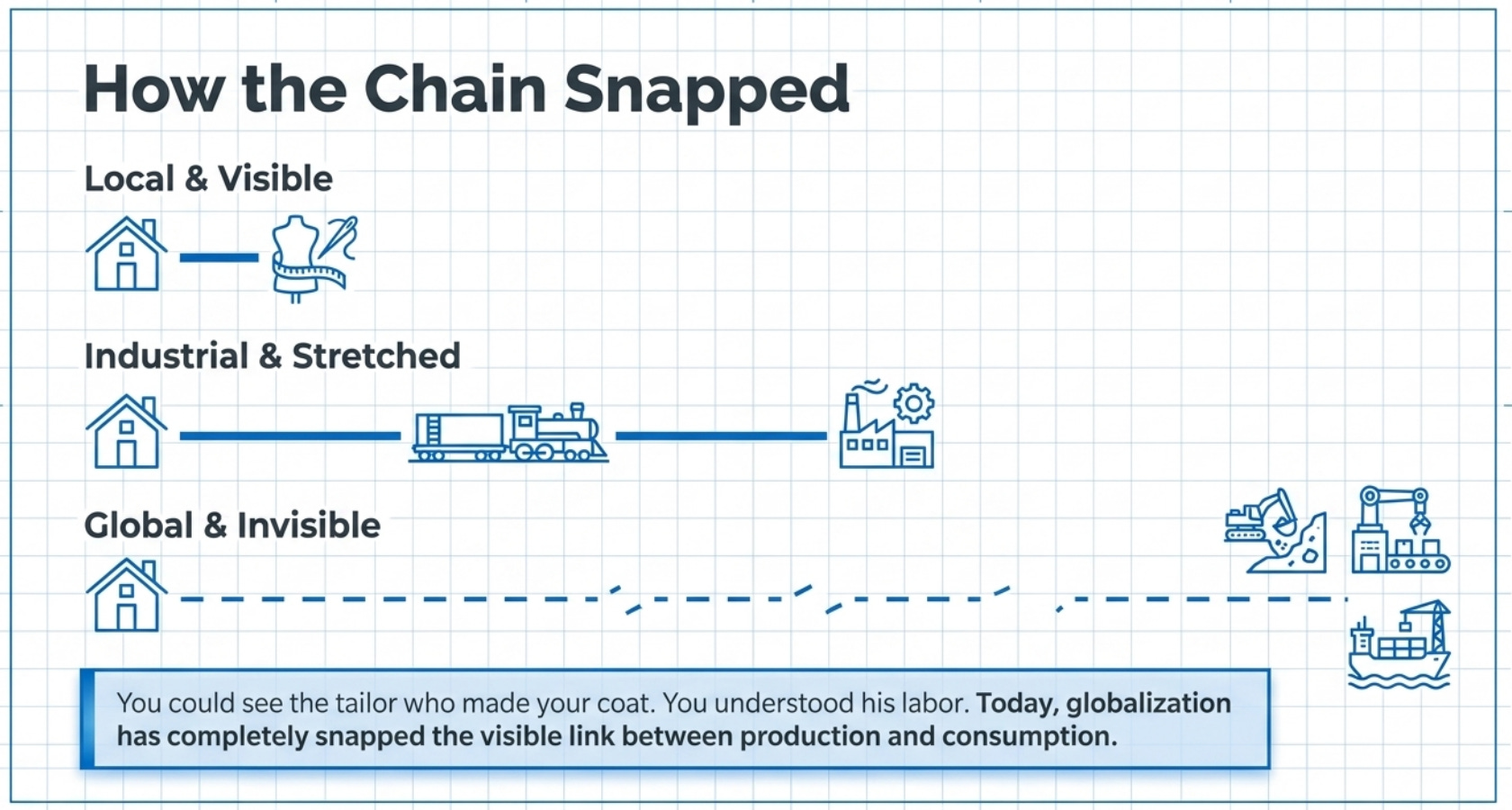
Today, you click “Buy Now” and a laptop appears. The supply chain that produced it the rare earth minerals from the Democratic Republic of Congo, the circuit boards assembled in Shenzhen, the final casing snapped together in Vietnam is entirely invisible. You know nothing of it. You were not meant to.
Minshall calls this “the illusion of explanatory depth.” Most of us believe we understand the objects we depend on. We don’t. And for decades, that was fine. Then it wasn’t.
The cost of efficiency
Here is the central irony. The fragility of modern supply chains is not the result of neglect. It is the result of excellence.
Over the second half of the twentieth century, manufacturers refined a doctrine called lean manufacturing. The core idea: eliminate waste. No excess inventory. No redundant suppliers. No buffer stock sitting in a warehouse somewhere, costing money. Every node in the network optimised to deliver exactly what is needed, exactly when it is needed.
This worked beautifully. Consumer prices fell. Delivery speeds accelerated. The whole system became a finely tuned machine.
But a finely tuned machine has no slack. And a system with no slack has no resilience.
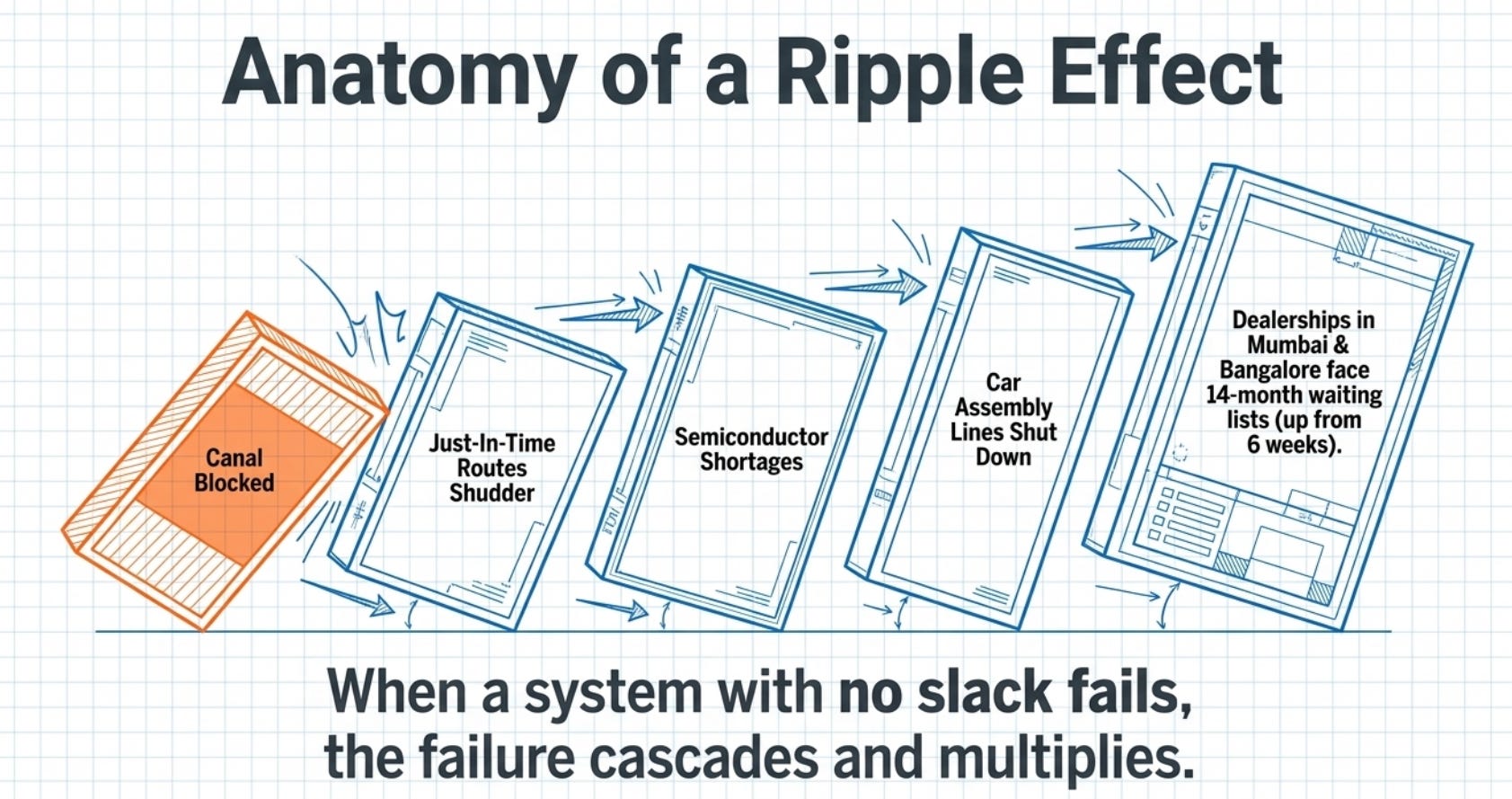
When a 220,000-tonne container ship ran aground in the Suez Canal in March 2021 and blocked roughly twelve percent of global seaborne trade for six days, every just-in-time supply chain linked to that corridor shuddered. Semiconductor shortages rippled into car factories. Car factories shut down assembly lines. Dealerships in Mumbai and Bangalore had waiting lists stretching to fourteen months for vehicles that would have shipped in six weeks the year before.
Nobody had planned for this because nobody had imagined it. Who builds a contingency for a ship getting stuck in a canal?
That is the nature of a system optimised for average conditions. It performs brilliantly until it doesn’t and when it doesn’t, the failure cascades.
The spider-web nobody can read
Minshall describes a researcher at Cambridge’s Supply Chain AI Lab who studies what large-scale supply networks actually look like when mapped in full. The image she shows him is described as “a mad multicoloured spider-web combined with a Magic Eye.” Each dot is a company. Each line is a trade relationship. One map, one product: a car.
The point is not complexity as abstraction. The point is that even the manufacturers at the centre of these webs often do not know what is at the edges. They know their tier-one suppliers. They may know their tier-two. Beyond that, the picture blurs. When something goes wrong deep in the network, a flood at a materials processor, a factory fire in a small town in Hubei, the ripple travels upward through layers no one was watching.
India understands this painfully. During the pandemic, the country’s pharmaceutical sector which supplies around twenty percent of the world’s generic medicines discovered that it was critically dependent on active pharmaceutical ingredients sourced from China. A sector that had built its global reputation on cost and scale turned out to be a middleman in its own supply chain. The government has since committed billions to domestic API manufacturing, but the structural vulnerability was decades in the making.
This is what happens when a system is optimised for normal. Normal is not guaranteed.
What the toy in the classroom taught us
Minshall’s book opens with a story about trying to explain manufacturing to a classroom of nine-year-olds. He brings in old computers and lets the children take them apart. The components pile up on a world map, circuit boards over China, cables over Mexico, a Mr. Incredible figurine that ends up, head twisted, over the biggest pile of all.
The children did not intend to build a lesson. They built one anyway. They could see, physically, on the table in front of them, that the things in their lives came from places they would never visit, made by people they would never meet, in conditions they had no way of knowing.
The lesson for adults is not sentimental. It is strategic. The more we understand about how manufactured goods arrive in our world, the better equipped we are to think about the risks embedded in that process: as consumers, as policymakers, as businesses building supply chains of our own.
The COVID-19 pandemic made this vivid. Supply chain resilience became the phrase on every politician’s autocue. But understanding is not rhetoric. Understanding requires actually knowing what happens inside the invisible factory.
What this means for how we think
Three things worth carrying from this:
The first is that efficiency and resilience are in direct tension. Every optimisation that removes cost also removes redundancy. The question for any supply chain whether you are sourcing APIs, semiconductors, or raw materials is not just “how lean can we go?” but “what happens when this breaks?”
The second is that visibility is power. The manufacturers who will navigate the next decade of disruption are not the ones with the most efficient networks. They are the ones who can see deeper into their own networks than their competitors can. The Supply Chain AI Lab exists because nobody can do this manually. The complexity has outgrown human cognition.
The third is that India is at an inflection point most countries crossed fifty years ago. As the country accelerates its manufacturing ambitions through Production Linked Incentive schemes, semiconductor fabrication investments, and “China plus one” positioning it has the rare advantage of building supply chains with the benefit of hindsight. It can build in resilience by design rather than retrofitting it after catastrophe. Whether it seizes that opportunity or replicates the same fragile efficiency-first logic will matter enormously.
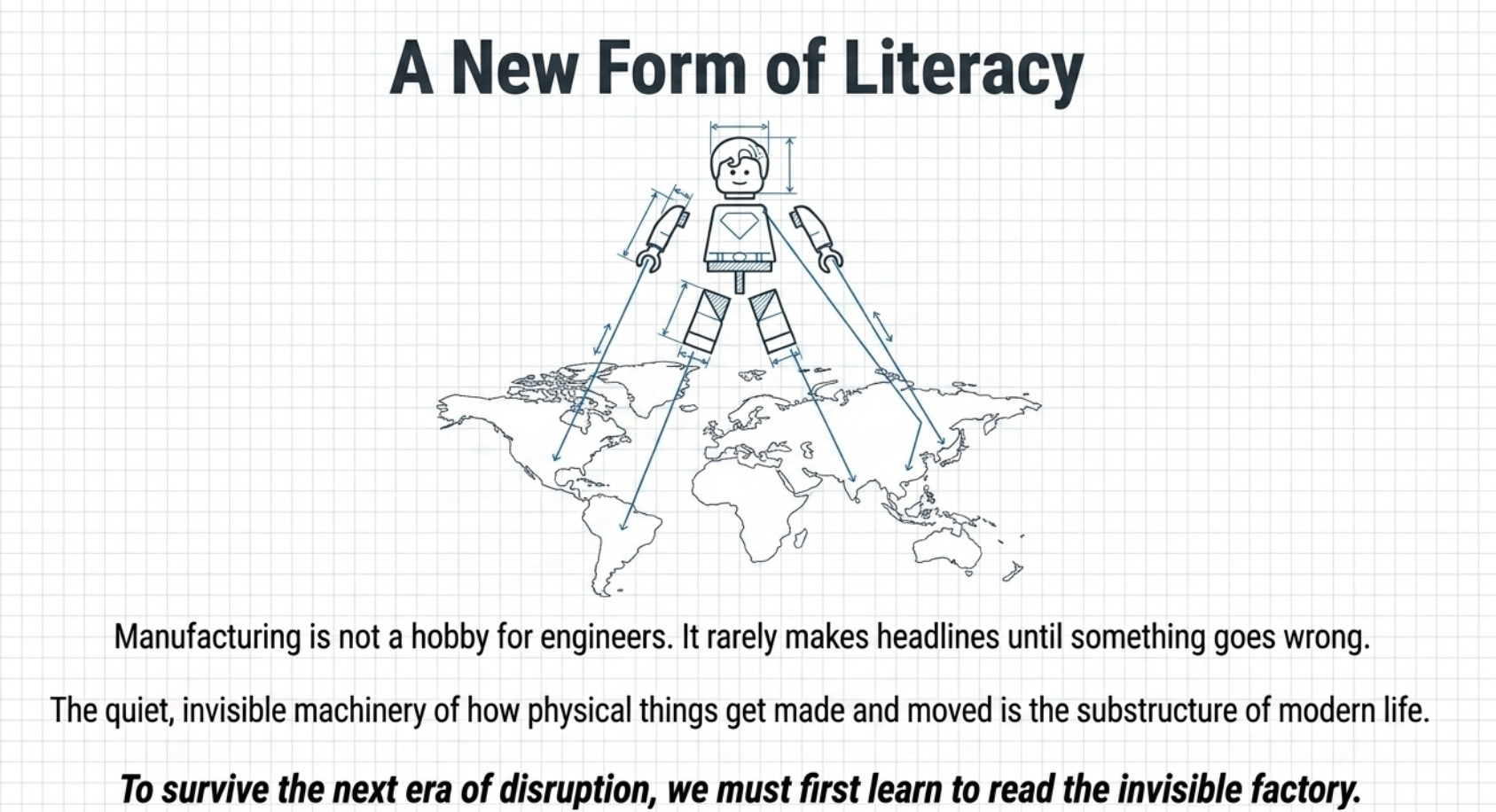
Manufacturing is not glamorous. It rarely makes headlines until something goes wrong. But the quiet, invisible machinery of how physical things get made and moved is the substructure of modern life. Understanding it is not a hobby for engineers. It is a form of literacy.
How Things Are Made by Tim Minshall is worth reading if you want to understand the world behind every object you own.