
The Hippies Built Your Computer
How a generation of dropouts, drug-takers, and anti-war protesters gave us the most powerful personal tool in human history

Nobody told you that the device you are reading this on was designed by people who were high.
Not metaphorically. Literally. The engineers, hackers, and researchers who invented the personal computer spent their evenings at the Stanford Artificial Intelligence Laboratory playing Spacewar, passing around joints, and believing, with the full force of their counterculture conviction, that a computer could set a human being free.
This is not a footnote. This is the whole story.
John Markoff’s What the Dormouse Said makes the case plainly: the personal computer was not born in a garage. It was born in the collision between military-grade computing ambition and a counterculture that decided the machine could belong to the individual, not the institution.
It is one of the strangest origin stories in the history of technology. And like the best ones, it teaches you something that still applies today.
Two labs. Two visions. One battle for the future.
In the 1960s, on opposite sides of Stanford University, two government-funded laboratories were racing toward the same territory from entirely different directions.
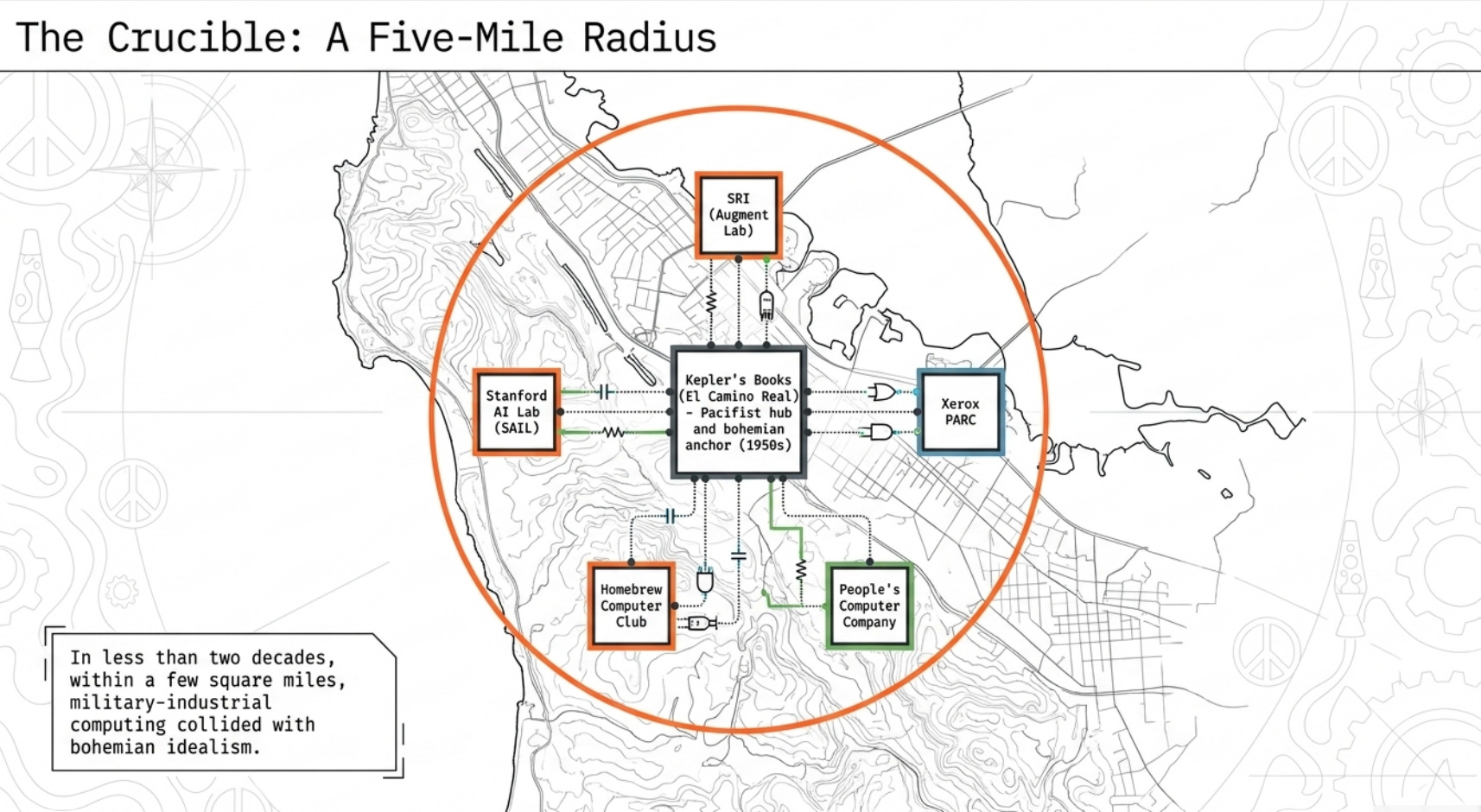
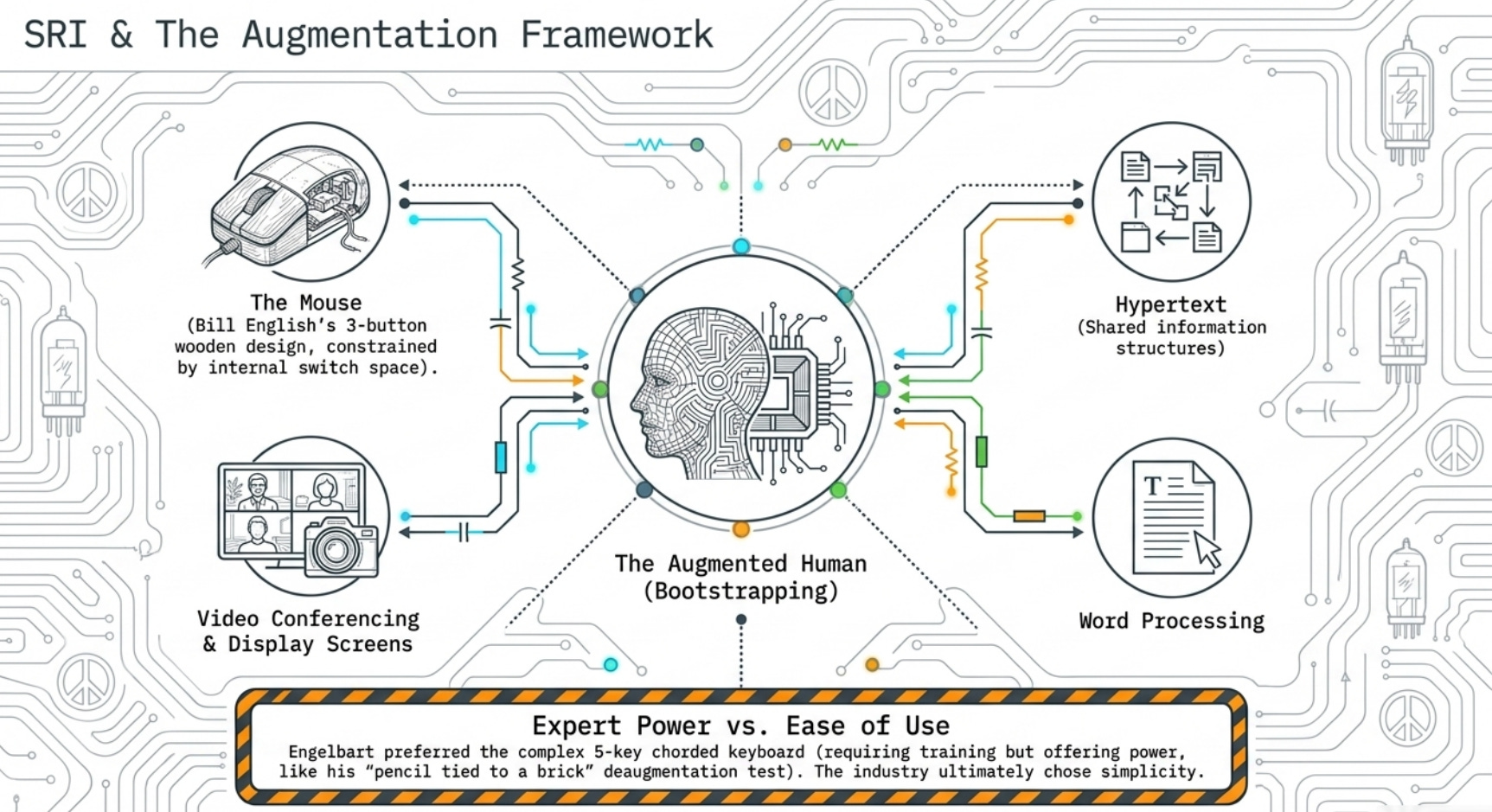
Douglas Engelbart’s Augmented Human Intellect Research Center at Stanford Research Institute was built on a single, almost spiritual conviction: that computing machines, if designed correctly, could massively amplify the power of the human mind. Engelbart wanted to make people smarter. He wanted to extend the intellect outward, like a prosthetic for thought.
Across the way, John McCarthy’s Stanford Artificial Intelligence Laboratory started from the opposite premise: build a machine that thinks like a human so you can replace the human.
One group wanted to augment intelligence. The other wanted to replicate it. The tension between these two philosophies tool versus replacement, amplifier versus substitute is not resolved. We are still living inside it right now, every time someone debates whether AI will empower workers or eliminate them.
They were asking the same question in 1965 that we are asking in 2025. That should unsettle you.
The Insight that Changed Everything
Here is what the people around Stanford understood before anyone else did.
The silicon chip had a strange mathematical property. Each time transistors shrank by half, the area available for circuits quadrupled. Computing power did not grow linearly. It grew exponentially. The cost fell. The size shrank. The capability exploded. If you grasped this truly grasped it, not just as data but as a worldview then the implications were staggering.
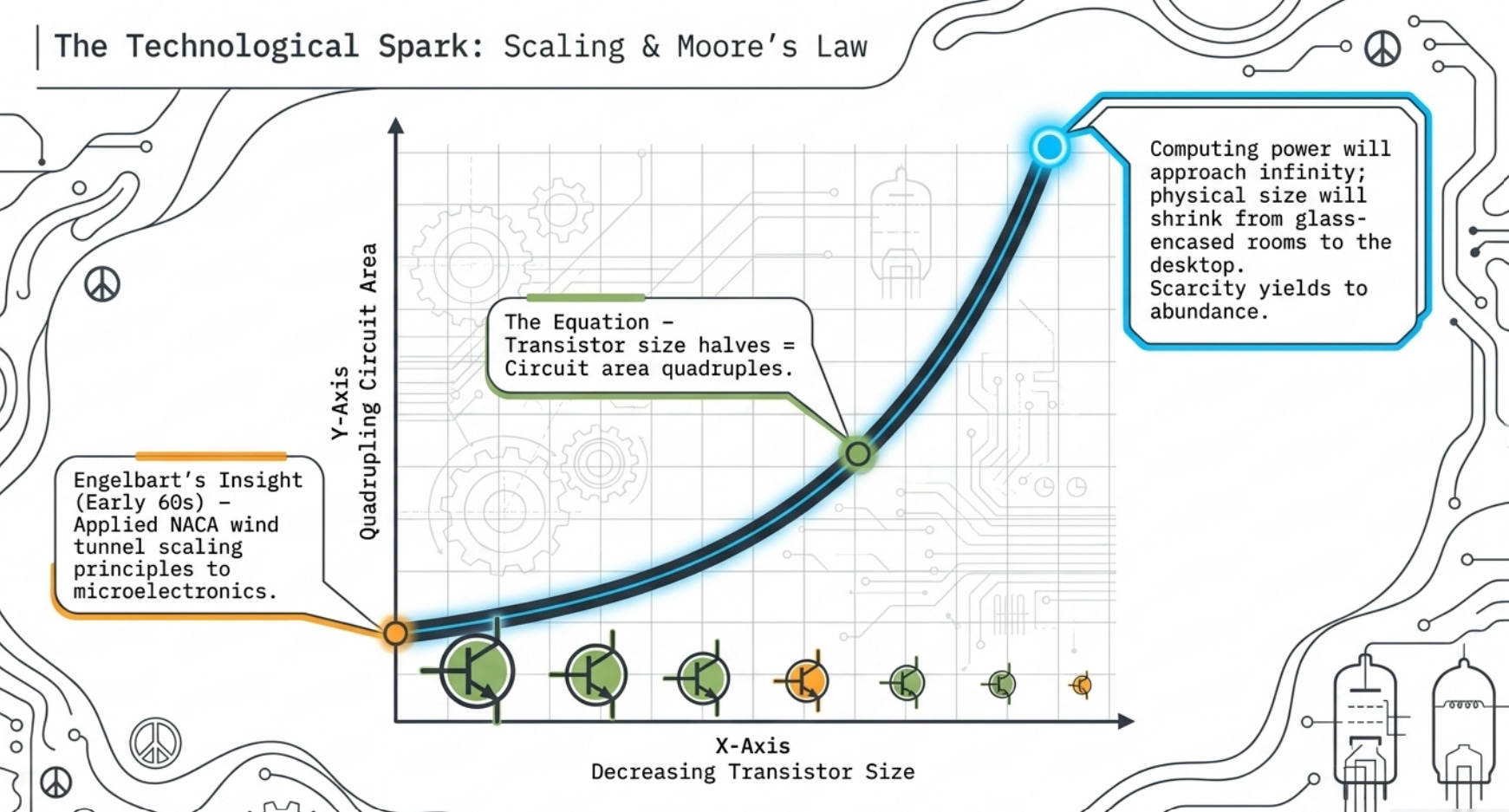
Intel’s Gordon Moore would later get the credit for articulating this in 1965, in what became known as Moore’s Law. But a handful of researchers at the Stanford labs had already seen it. They had already made the leap.
The leap was this: computing was not going to remain locked in the hands of IBM and the Pentagon and the bureaucrats in their glass towers. It was going to shrink until any person could hold it. And when it did, it would be, in every meaningful sense, a revolution.
Stewart Brand, the Whole Earth Catalog founder and countercultural oracle, put it this way: “The counterculture’s scorn for centralized authority provided the philosophical foundations of not only the leaderless Internet but also the entire personal computer revolution.”
The people who built the PC did not want to sell you a product. They wanted to blow up the establishment.
The Performance that Nobody Noticed
Here is the underrated detail in this history.
When Rolling Stone journalist Stewart Brand visited the Stanford AI Laboratory in 1972, he found something extraordinary. During the day, the lab’s expensive government-funded computers were running serious research. At night, the same machines were turned into arcade games. The researchers played Spacewar for hours. They were, Brand wrote, “heads, most of them.”
Half of computer science was hippies.
This is the part that never makes it into the clean origin stories. The people who invented the mouse, the graphical interface, the concept of a network of individuals sharing information, were not buttoned-up engineers optimizing for productivity metrics. They were people who had read the Whole Earth Catalog, who had attended Free University lectures, who had been shaped by the antiwar movement, and who believed, with genuine philosophical conviction, that centralized power corporate or governmental was the enemy of human potential.
The PC was not just a product. It was a political act.
Douglas Engelbart understood this most clearly. His famous 1968 demonstration the one historians now call “The Mother of All Demos” unveiled, in a single ninety-minute session, the mouse, video conferencing, collaborative real-time editing, and the graphical interface. The audience sat in stunned silence. Engelbart was not showing them a gadget. He was showing them what a liberated human mind, supported by the right tools, could do.
The tragedy is that Engelbart never got the credit. By the time Apple and Xerox PARC commercialized his ideas, he had already moved on, searching for deeper problems. The man who invented the tools that define our world is barely a footnote in most technology histories. That is a pattern worth noting.
The real lesson from the people who built the future
There is a version of this story where the counterculture is just color. A fun backdrop. The drugs and protests as local texture while the real work happened in labs and chip factories.
That version is wrong.
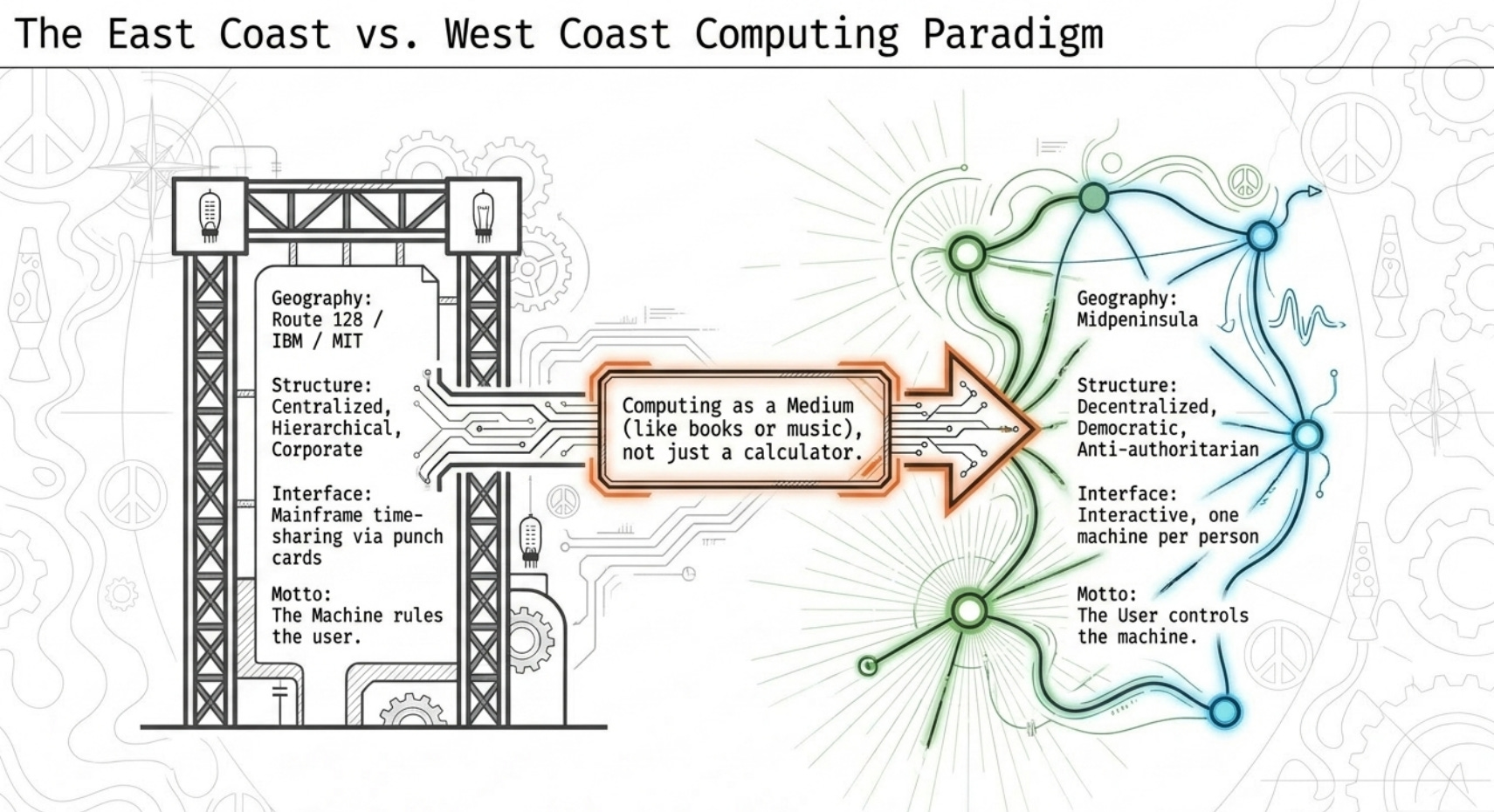
The reason personal computing emerged first in California and not on the East Coast is not geography. It is philosophy. MIT and the Route 128 corridor in Massachusetts had the technical talent. They had brilliant researchers and early experiments with single-user machines. What they lacked was the conviction that the computer should belong to the individual.
The East Coast computing world was hierarchical. Formal. IBM-shaped. Ken Olsen, the founder of Digital Equipment Corporation, publicly stated in the 1970s that there was no reason for a home computer. He had the technical capability to build one. He simply could not imagine why anyone would want it.
The people on the Midpeninsula could not imagine why anyone wouldn’t.
That difference not talent, not capital, not even technology is what created Silicon Valley.
What the dormouse teaches us
1. The establishment always thinks the revolution is for someone else. IBM had the technology and the scale to own personal computing. They thought it was a toy. The people who built it thought it was freedom.
2. Countercultures don’t just protest. They build. The 1960s counterculture is remembered for what it opposed. Less remembered is what it created. The architecture of how we communicate, create, and compute today was shaped by people who believed radical things about human potential.
3. Vision without timing is delusion. Timing without vision is just luck. The engineers around Stanford saw Moore’s Law before Moore named it. Seeing the exponential curve coming and betting your career on it that combination of clarity and courage is what separates builders from observers.
4. The tool reflects the values of its maker. The personal computer was deliberately designed to decentralize power. That was not an accident of engineering. It was a philosophical choice. The question worth asking about any new technology: whose values are embedded in it?
The machine you hold in your hand was built by people who believed it could set you free. Are you using it that way?
If this made you think differently about your phone, your laptop, or where the future is actually built, pass it on.