
The Chip That Built a World: Intel and the Making of Silicon Valley
How a band of renegade scientists invented the modern age, one transistor at a time

There is a moment in the history of Silicon Valley that most people have never heard of, but without which none of what followed would have been possible.
It is September 1957. Seven engineers are parked in a driveway in Los Altos, California, hearts hammering, waiting to see if their colleague Bob Noyce will walk out his front door and join their rebellion against Nobel laureate William Shockley. Noyce is their natural leader, the most charismatic physicist of his generation. He does walk out. And in that single act of defiance, Silicon Valley as we know it is born.
Those seven men, with Noyce as their eighth, would come to be called the Traitorous Eight, an epithet bestowed by an enraged Shockley that they would wear as a badge of honour. They founded Fairchild Semiconductor, seeded an entire generation of technology companies, and launched two of the three men who would go on to build one of the most consequential corporations in human history: Intel Corporation.
To understand Intel’s impact on Silicon Valley and on modern civilisation, you have to begin here. Not in a gleaming campus in Santa Clara, but in a driveway in Los Altos, with eight brilliant men deciding to bet everything on each other.
The Trinity
Intel’s story is the story of three very different men.
Robert Noyce was the son of an Iowa preacher: magnetic, confident to the point of recklessness, a man who once stole a piglet from a local farmer for a luau while at Grinnell College and nearly got expelled. He was the kind of man who could charm investors, scientists, and senators in the same afternoon. When he resigned from Fairchild in 1968, he told his colleague Gordon Moore about it while standing in his front yard, almost casually. The conversation planted a seed. A month later, Moore quit too, bringing with him a quiet, ferociously driven engineer from Hungary named Andy Grove.
The three agreed that the future lay in computer memory chips, a market almost entirely driven by technology. Whoever could pack the most circuits onto a chip would lead the industry. To fund the venture, Noyce called venture capitalist Arthur Rock, who had already made his name backing Fairchild. Legend has it Noyce raised the startup capital in roughly five minutes.
Intel was born.
The Invention That Changed Everything
Intel’s early years were focused on memory chips, a business in which it excelled almost immediately. But the company’s true destiny arrived in 1969 through an unlikely source: a Japanese calculator company called Busicomp.
Busicomp wanted Intel to design a set of custom chips for its desktop calculators, a cluster of specialised chips each assigned a single dedicated task. Employee number 12 at Intel, a soft-spoken Stanford researcher named Ted Hoff, found this approach inelegant. He had been working with a Digital Equipment minicomputer and was struck by how a simple but universal instruction set could enable extraordinary complexity through software. Why couldn’t the same logic apply to a chip?
The Japanese engineers were unmoved. They wanted calculators, not philosophy. But Noyce and Moore told Hoff to keep going.
By October 1969, Hoff had refined the idea enough to present it back to the Japanese, and this time, they understood. What Hoff had conceived was not just a better calculator chip. It was something the world had no word for yet: a general-purpose programmable chip. A computer on a sliver of silicon. The microprocessor.
The Intel 4004, delivered in 1971, was the first. It was followed quickly by the 8008, and then the 8086, the ancestor of the x86 architecture that still powers most of the world’s computers today. Intel’s marketing head at the time initially worried that the total global market for microprocessors might be 2,000 chips a year. Within a decade, the company was shipping millions.
It is difficult to overstate what this invention meant. The microprocessor did not just make computers smaller and cheaper. It made computing everywhere, embedded in cars, medical devices, telecommunications equipment, and eventually the pocket-sized supercomputers we call smartphones. Every aspect of modern industrial civilisation runs on logic that traces its lineage to Ted Hoff’s insight in a Santa Clara office in the summer of 1969.
Moore’s Law: The Metronome of Modernity
Before Intel, Gordon Moore had published a short article in Electronics magazine in 1965. His observation was modest: the number of transistors that could fit on an integrated circuit had been doubling roughly every year, driving costs down dramatically. He predicted this trend would continue.
What he could not predict was that this observation would become Moore’s Law, the organising principle of the technology industry for the next half century. Not just a prediction, but a commitment. A self-fulfilling prophecy. A competitive pressure that forced every engineer in the industry to push harder, faster, further, year after year.
Intel made Moore’s Law its north star. The company poured its resources into manufacturing precision and chip architecture with a singular obsession: keeping the doubling on schedule. It was a brutal discipline. Intel’s factories had to achieve tolerances measured in atoms. Entire product lines had to be scrapped and reinvented every two years. Engineers worked with the knowledge that if they did not solve the next problem in time, someone else would.
The result was the fastest sustained pace of technological progress in human history. Processing speeds, memory capacity, and storage density all grew exponentially for decades. The laptop you might be reading this on is roughly a million times more powerful than the room-sized computers of the 1960s, at a fraction of the cost. Moore’s Law made that possible. Intel made Moore’s Law real.
The Culture That Reshaped a Valley
Intel’s impact on Silicon Valley was not only technological.
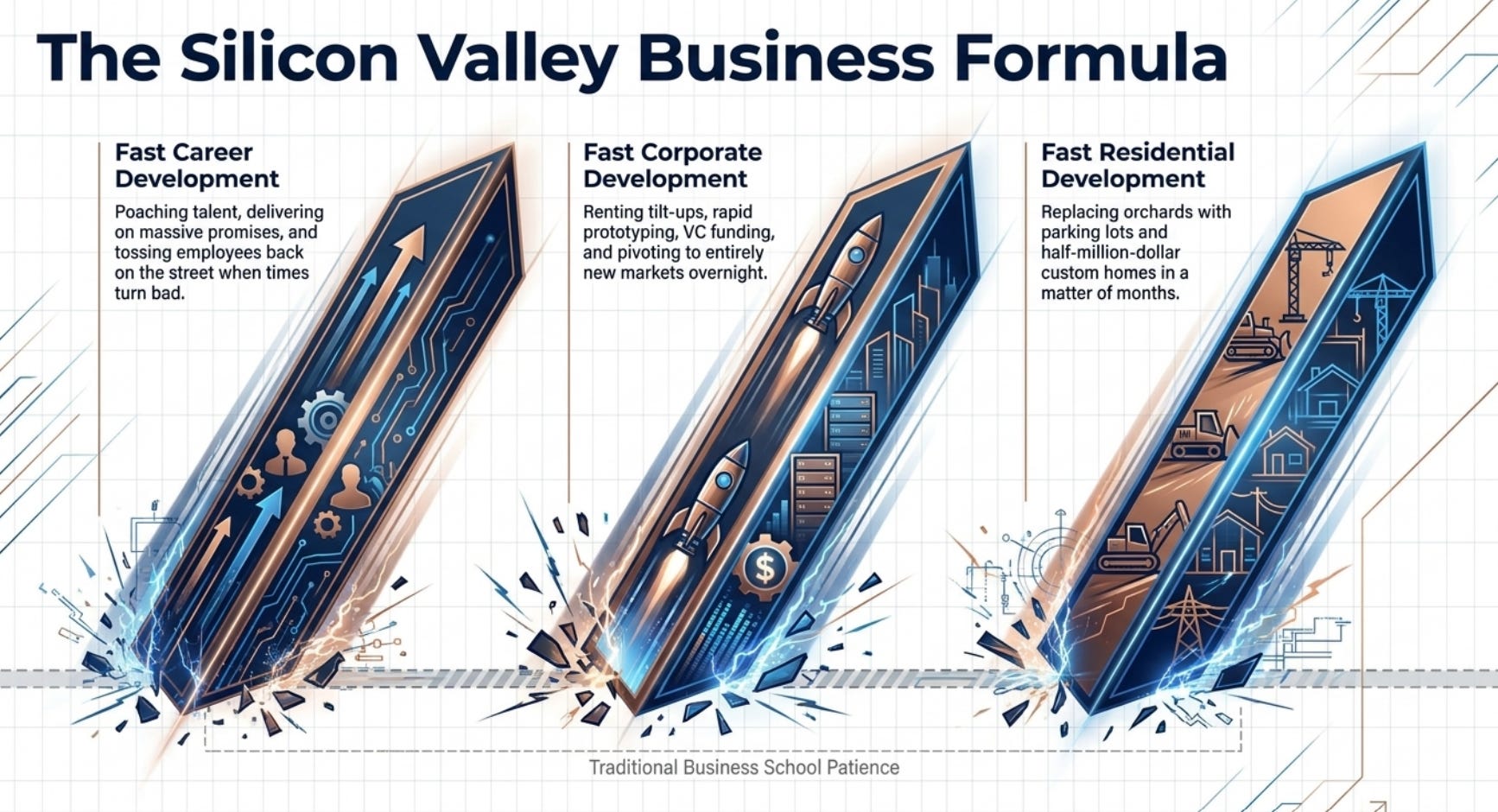
The company’s internal culture became a template, imperfect and contested but enormously influential, for how technology companies thought about management.
Walk into Intel in the early 1970s and you encountered something almost unthinkable in the corporate world: a sea of cubicles. Not just for junior employees. For everyone. Noyce worked at a standard white vinyl pull-out desktop, identical to anyone else’s, except with the National Medal of Invention tacked to the wall where others kept vacation photos. Grove and Moore were often scattered across different buildings entirely. There was no obvious headquarters, no corner office culture, no visible hierarchy of power.
This was a radical statement. America in the 1970s still operated on the logic of the Organisation Man, rank expressed through physical space and authority maintained through title and access. Intel rejected all of it. The founders had come to California partly to escape that world, and they built something different: a meritocracy of ideas, where what you knew mattered more than where you sat.
Andy Grove formalised this into a management philosophy that became enormously influential. His insistence on “constructive confrontation,” the norm that anyone in the company could challenge anyone else’s idea regardless of seniority, created an environment where bad decisions got killed before they became disasters. His book High Output Management, published in 1983, became required reading for a generation of technology executives.
Companies like Apple, Google, and countless startups absorbed these lessons, the flat hierarchies, the open offices, the engineering-first cultures, sometimes imperfectly and sometimes superficially, but always with Intel somewhere in the genealogy of the idea.
The Invisible Infrastructure
Here is the strange legacy of Intel: the company built the foundation on which the modern digital world rests, and most people have never thought about it for a single second.
You know Apple’s name. You know Google’s name. You know Zuckerberg and Musk and Bezos. But Robert Noyce, the man who co-invented the integrated circuit, who mentored Steve Jobs, who was once called the Mayor of Silicon Valley, died in 1990 without a Nobel Prize, without streets named after him, without the global recognition that should have been his. When Jack Kilby of Texas Instruments won the Nobel Prize for the integrated circuit in 2000, Kilby himself noted graciously that had Noyce lived, he would certainly have shared the award.
This invisibility is part of what makes Intel’s story so striking. The company did not make something you could hold in your hand and immediately understand. It made the thing inside the thing, the engine beneath every other engine. The microprocessor is infrastructure. And like all great infrastructure, we notice it only when it fails.
But infrastructure is not passive. It shapes what is possible. The particular architecture of Intel’s chips, the particular cadence of Moore’s Law, the particular culture of engineering excellence that Grove instilled, all of these determined what kinds of companies could exist, what kinds of products could be built, what kinds of futures became imaginable.
Which raises a quieter question: if the microprocessor had been invented somewhere other than Santa Clara, by people shaped by a different set of rebellions and driveway conversations, would the world it produced look anything like the one we have?
Sources: Michael S. Malone, The Intel Trinity (2014); The Big Score: The Billion-Dollar Story of Silicon Valley (1985/2021)