

In 1694, William III’s government was running short of money. War with Louis XIV’s France was expensive, England’s machinery for public borrowing was still primitive, and anyone lending to the Crown had reason to remember what happened in 1672, when Charles II stopped payments from the Exchequer.
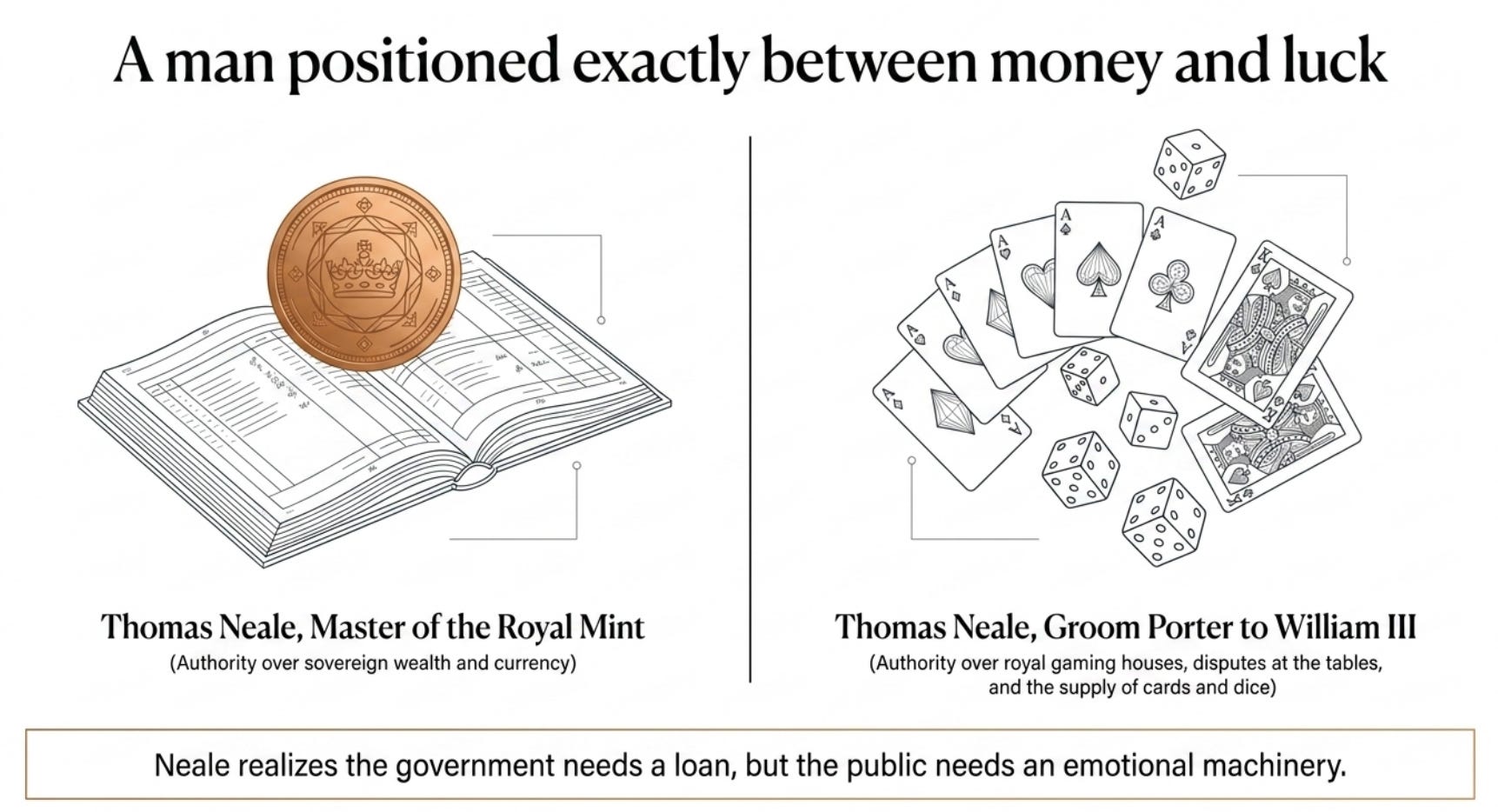
Thomas Neale had an answer. His official career was wonderfully suited to the problem. He was Master of the Royal Mint, but also Groom Porter to William III, an old court office that put him in charge of gambling around the royal household. Neale supplied cards and dice, dealt with disputes at gaming tables and exercised authority over gaming houses. He spent his working life somewhere between money and luck.
His proposal carried the magnificent seventeenth-century title A Profitable Adventure to the Fortunate, And can be Unfortunate to None.
The plan was to sell 100,000 tickets at £10 each, raising £1 million for the government. A ticket was more than a lottery entry. Each holder was entitled to an annual payment for sixteen years, while tickets drawn as prizes received much larger payments.
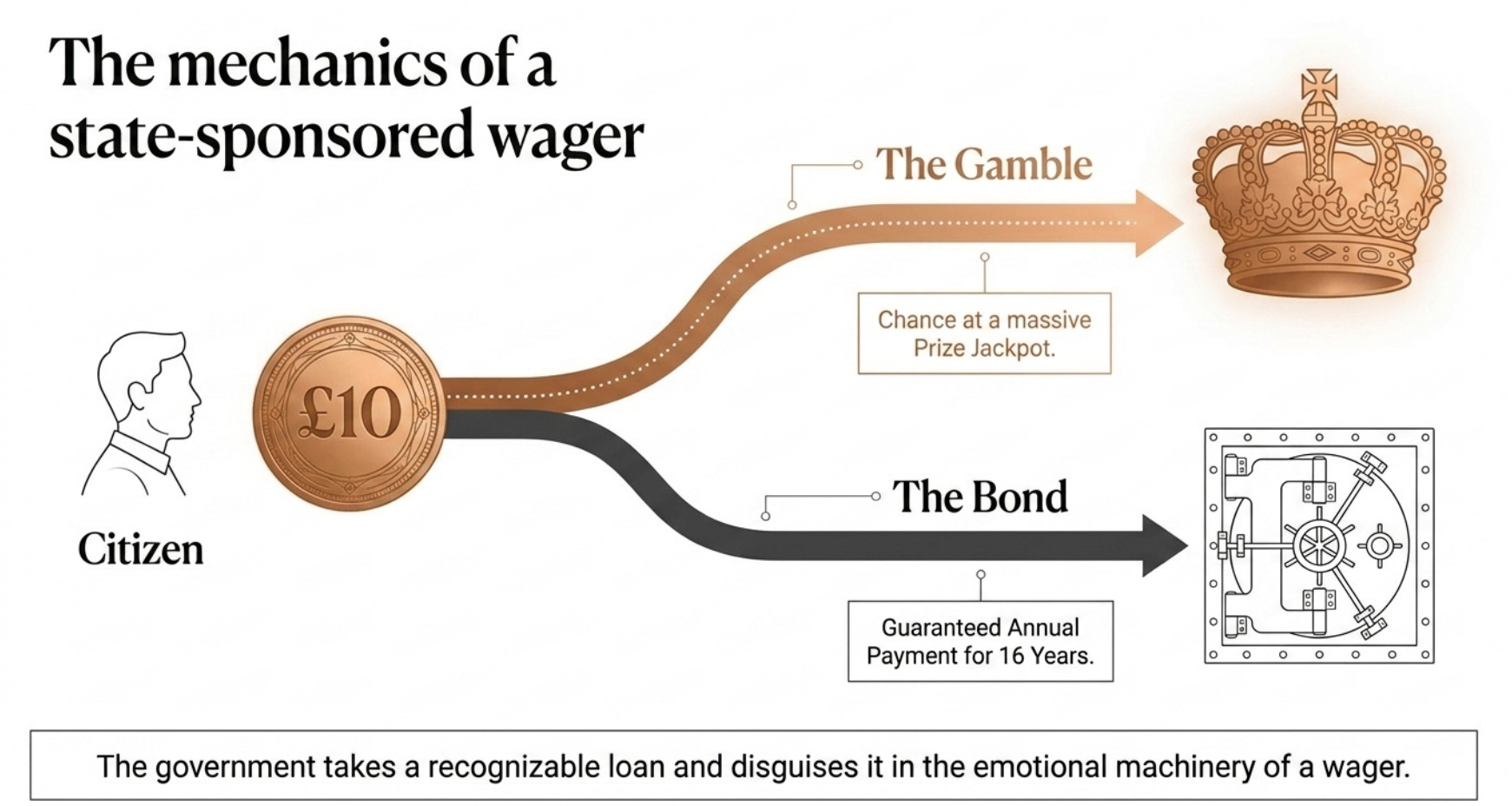
The government had taken something recognisable as a loan and given it the emotional machinery of a wager.
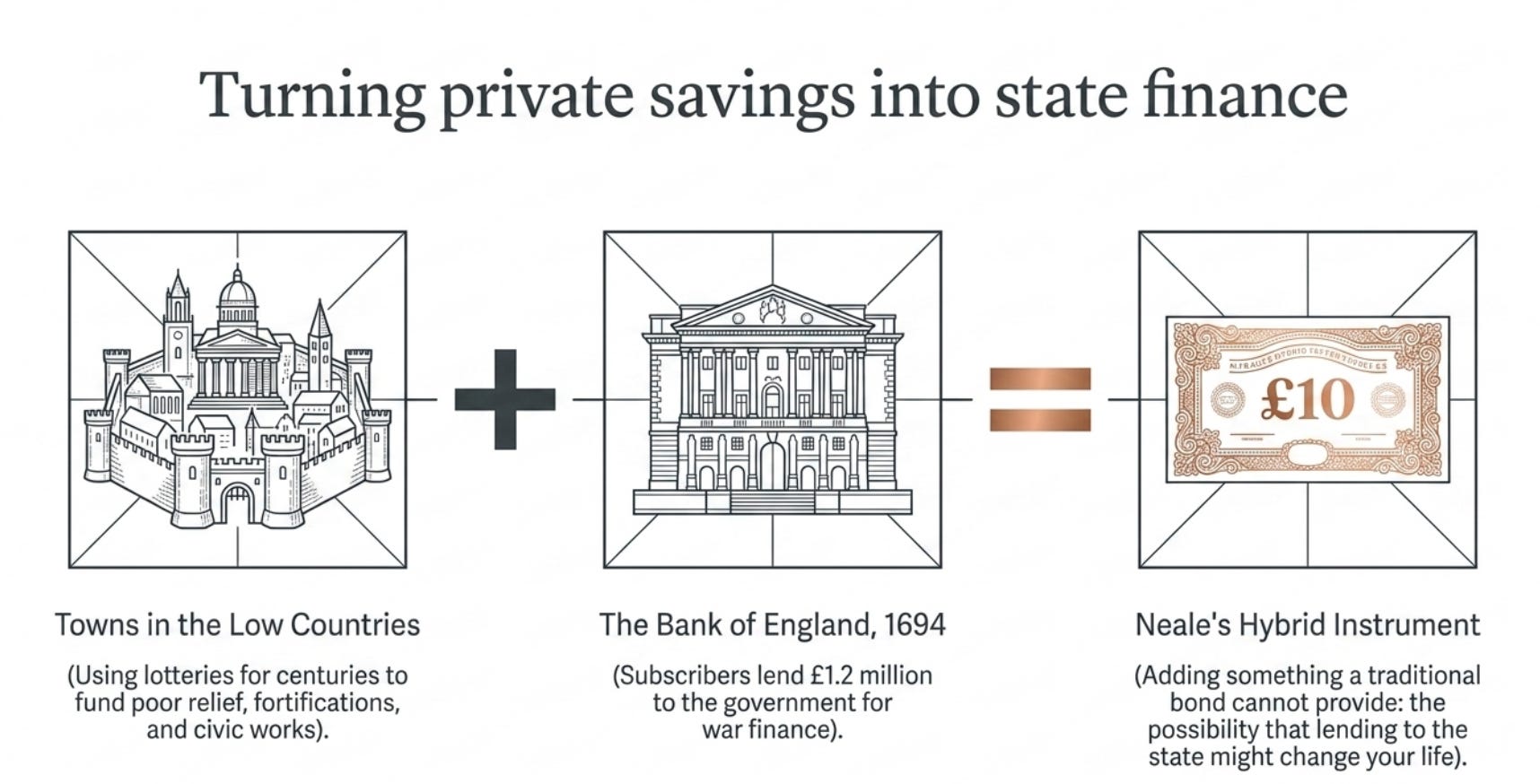
Neale had not invented this. Towns in the Low Countries had been running lotteries for centuries to pay for fortifications, poor relief and civic works.
Surviving lottery records from the fifteenth and sixteenth centuries contain little rhymes, prayers, jokes and appeals to saints written by people entering the draws. This was clearly not how people behaved when purchasing an ordinary stream of income. A lottery allowed a modest sum of money to carry a wildly immodest future.
That was useful to a government trying to borrow.
The same year produced another experiment in public finance. The Bank of England was founded in 1694 after subscribers lent £1.2 million to the government. England was discovering ways to turn private savings into war finance, and Neale’s lottery loan belonged to that same search. Except Neale had added something a bond could not provide: the possibility, however remote, that lending to the government might change your life.
There is a second history running beside this one.
The gamblers’ question
Forty years before Neale’s scheme, a French nobleman and gambler, the Chevalier de Méré, had been bothering Blaise Pascal with questions about games of chance. One of them concerned an old puzzle known as the problem of points.
Two players put money into a pot and begin a game. The first to reach a certain number of wins gets everything. Before the game finishes, they are forced to stop. One player is ahead.
Who gets how much?
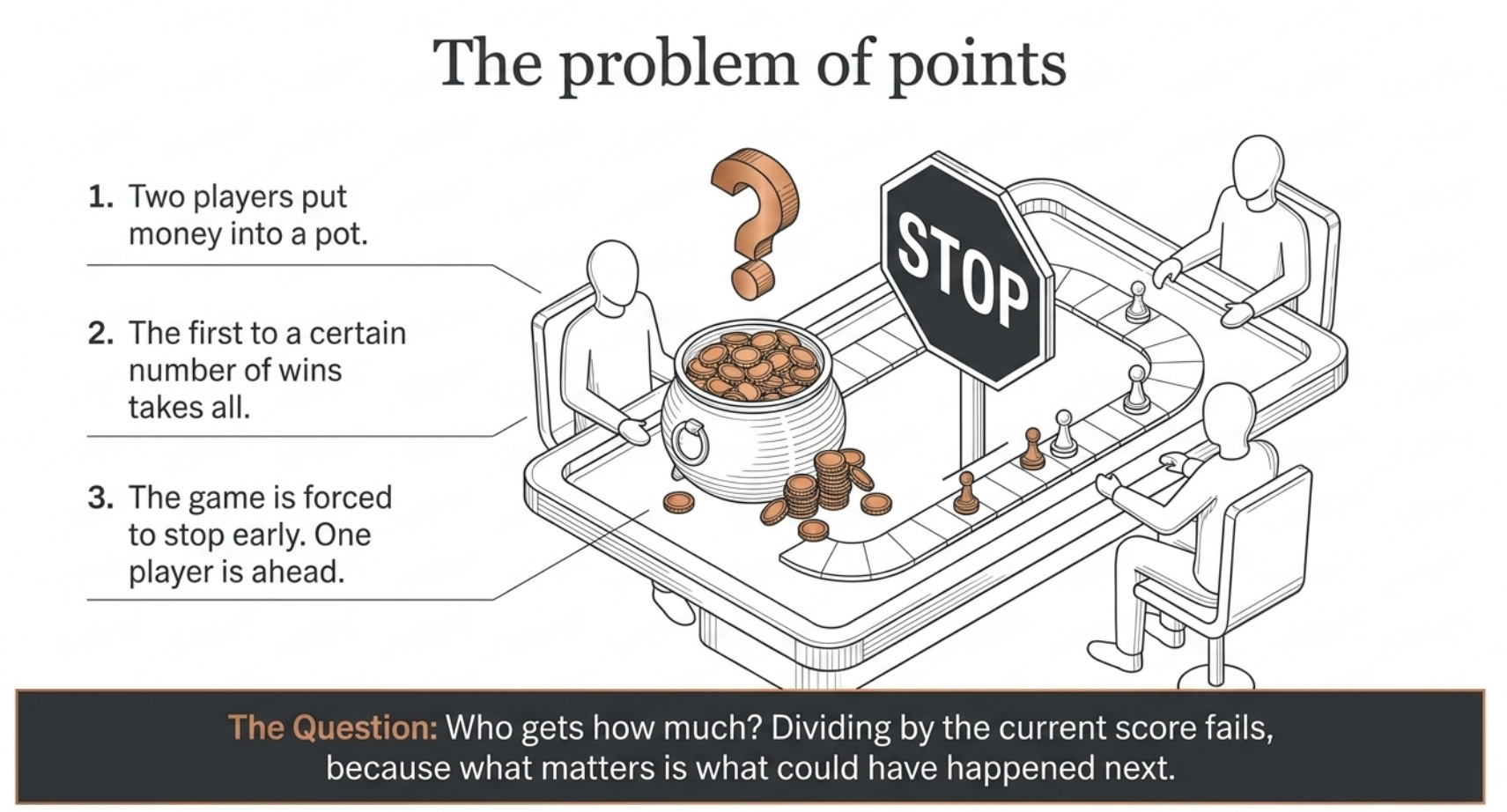
Dividing the pot according to the score so far does not work, because what matters is what could have happened next. Pascal discussed the problem with Pierre de Fermat in 1654. Their correspondence became one of the foundations of probability theory. Christiaan Huygens soon produced a systematic treatment of calculating expectations in games of chance.
Gamblers had handed mathematicians a peculiar object: money whose value depended on events that had not happened.
Dice were useful because they made the problem unusually clean. There were a finite number of outcomes, the rules were known and the stakes could be counted. Once mathematicians could reason about uncertain payments at a gaming table, similar questions appeared elsewhere. What is a life annuity worth if nobody knows when its owner will die? How much should an insurer charge when it cannot know which ship will sink? What should someone pay for a claim on money that may or may not arrive years later?
The connection between gambling and finance was not that one invented the other. Probability did not create finance, of course. Merchants had lent money and insured voyages long before Pascal.
Gambling supplied mathematics with a laboratory in which uncertainty could be stripped of most of the messiness of real life.
Neale’s lottery supplied a different experiment.
He did not have to predict which ticket would win. The prizes had already been specified. Sell 100,000 tickets at £10 and the government knew how much money would arrive; it also knew what the scheduled payments would cost. What remained unpredictable and intoxicating for each ticket holder was manageable in aggregate for the institution running the draw.
That gap became economically valuable.
Later mathematics would make it much easier to understand. Jacob Bernoulli’s work on repeated trials showed why enough observations could turn erratic individual outcomes into surprisingly regular patterns. Insurance, casinos and lotteries would all come to depend on versions of the same comfort: nobody needs to know what happens to the next person if the behaviour of a sufficiently large crowd can be estimated.
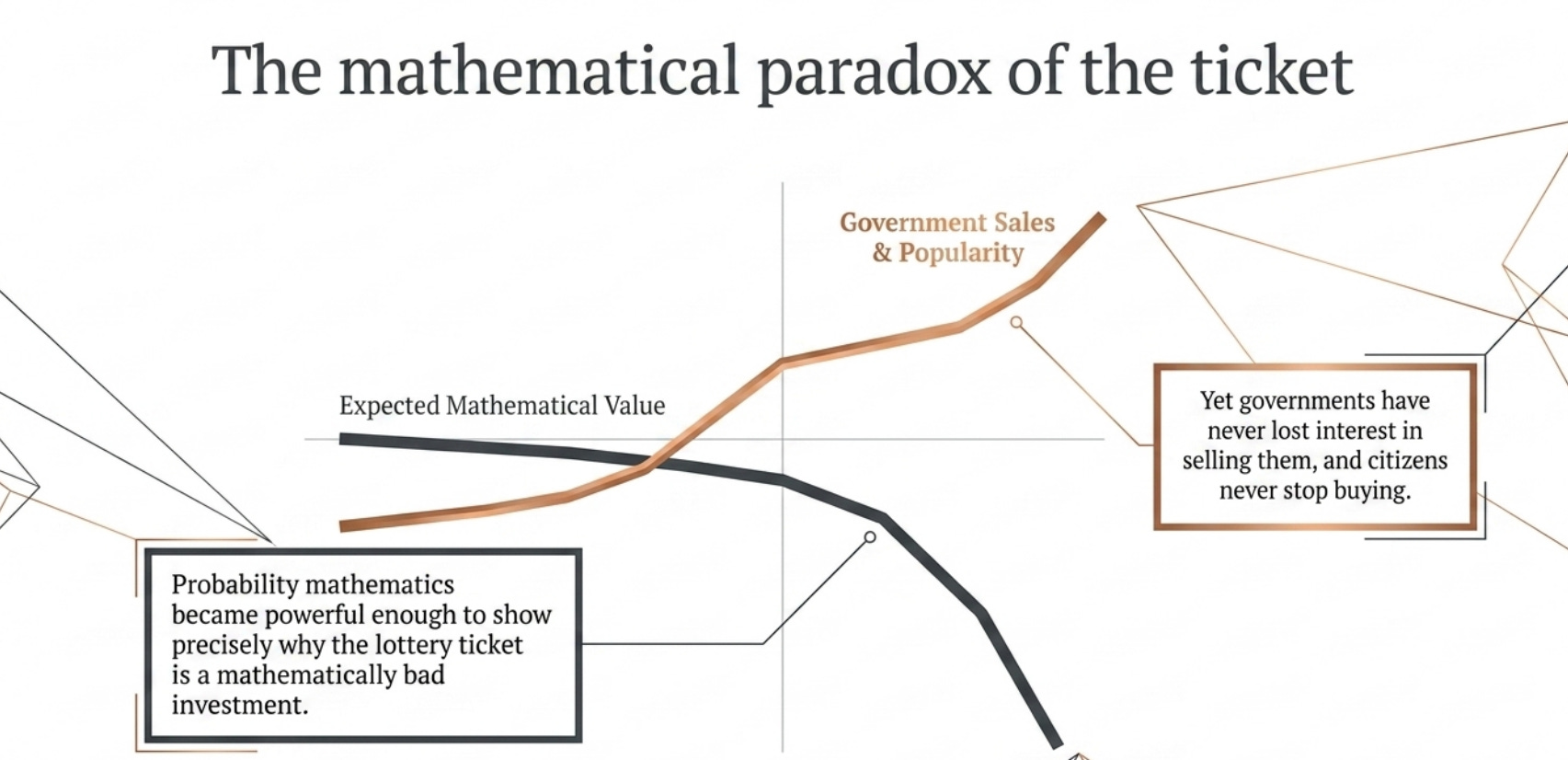
The amusing part is what happened afterwards. Probability mathematics became powerful enough to show precisely why the lottery ticket is usually a bad investment. Yet governments never really lost interest in selling them.
Perhaps Thomas Neale had already discovered the reason.
A bond asks you to calculate. A lottery lets you imagine.